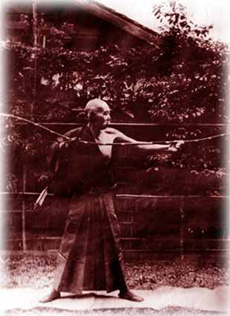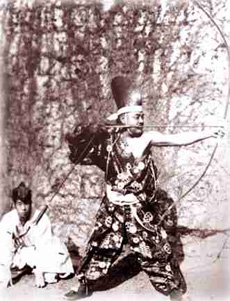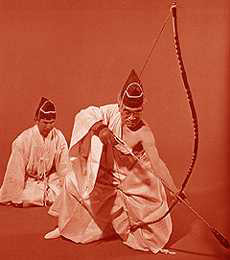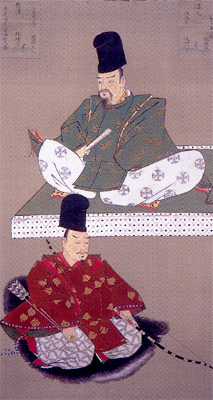
The house of Ogasawara was specialized in the superb technique of the Japanese equestrian, archery and propriety, moreover, their name can be unforgettable in the history of Japanese martial arts, because they developed the Yabusame and the marital arts not only physical but also deep spiritual exercise and technique closely related to the religious ritual. Nowadays in Japan, general martial artists respecting propriety, deeply consider that the spirit lf purification within souls and bodies is what they must pursue throughout their lives. The richness lf aesthetic sense and the spirit cannot be bought.
@

The house of Ogasawara is a pure blooded lineage lf the Seiwa Genji clan. The 1st patriarch, Nagakiyo Ogasawara was born in Koshu ( nowadays it is known as Yamanashi prefecture) in 1162, his father was Kagami-jiro-tomitsu, mother was anonymous but known as a daughter of Wada yoshimori.
The Ogasawar village had been really existed, however, the name changed and it became the Minami Alps city recently.
It has been said that the surname "Ogasawara" was provided by the Emperor Takakura and Nagakiyo is an original ancestor of all the families named "Ogasawara" today. When Ogasawara-nagakiyo was 26 years old, he became a personal equestrian archery and marital tutor of Minamoto-yoritomo, who is known as the prominent and powerful military general of the Kamakura shogunate and later on, all the superb technique and spirits of the equestrian archery and martial arts were directly succeeded to Nagakiyo's first son, Nagatsune.
The Ogasawara served the military general of the Kamakura era ( the Minamoto shogunate), the Muromachi era(the Ashikaga shogunate), and the Edo era(the Tokugawa shogunate) as the martial mentor, that is the most significant and famous fact to be mentioned throughout the Japanese history

In the era of the Tokugawa shogunate, the descendants of the Nagatada's lineage had been living though their times as the owners of the several castles, the Kokura castle in Kyusyu, Karatsu in Saga prefecture in Kyusyu, and Echizen Katsuyama in Fukui prefecrure until the Meiji era.
Ogasawara-tsunenao, the 17th patriarch of the house of Ogasawara, he had been invited by Tokugawa-ieyasu, the greatest and most prominent general and the establisher of the Edo (Tokugawa) shogunate and he became a personal martial tutor of Tokugawa-ietada, son of Ieyasu. Ogasawara-tsunenao served the Tokugawa shogunate as the royal servant until the restoration

@

@
The 28th patriarch Ogasawara-kiyokane served the Tokugawa shogun as the imperial officer and in 1862 and he totally organized the royal wedding of Princess Kazunomiya, a sister of the Emperor Komei.
In 1879, he dedicated the Yabusame ceremony at the Fukiage Imperial Palace. His Yabusame ceremony was often observed by the Emperor Meiji at the Ueno Park.
In 1880, Ogasawara-kiyokane opened The Ogasawara school of propriety and horsemanship to the public in Kanda Tokyo and he taught mainly the propriety at the girls schools.

The 29th patriarch Ogasawara-seimei dedicated ritual Yabusame ceremony to celebrate a new establishment of the Meiji Shrine in 1920. He strove to revive the Yabusame ceremony at many shrines like The Tsuruoka Hachimangu Shrine, The Nikko Toshogu Shrine, The Kasama Inari Shrine and so on.

The 30th patriarch Ogasawara-kiyonobu dedicated the ritual Yabusame ceremony which is represented by the one held on 3rd May every year at The Kamo-Mioya Shrine in Kyoto. He contributed the Yabusame and other ritual archery ceremonies, The Ohmato-Shiki, The Momote-Shiki, and The Kusajishi-Shiki.
Kiyonobu worked so hard through his life to correct the wrong social insight about the Ogasawara propriety, which had been kinked by a money grubbing commercialism. He strove to familiarize the public with the correct and traditional aspect of the Ogasawara propriety with scientific evidence.